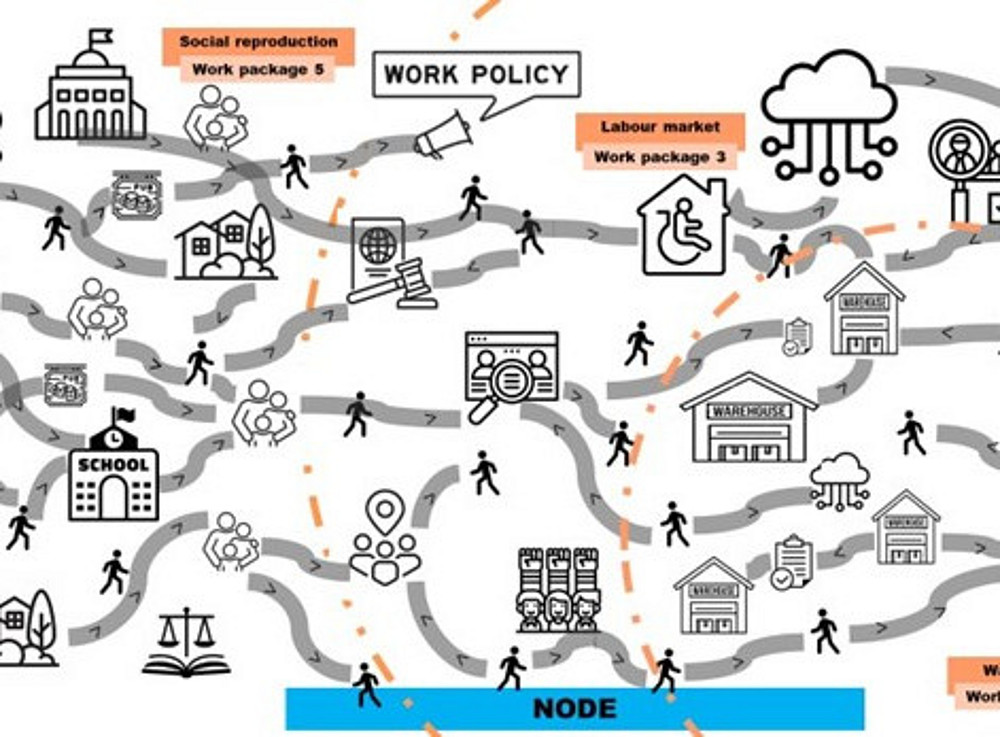
On 1 January 2026, the international research project LABOURFLOWS – Infrastructures of Labour Power Flows commenced. The project is led by Prof. Renate Ortlieb and funded by the Austrian Science Fund (FWF) with approximately EUR 238,000 (total project volume: around EUR 880,000). Project partners are Prof. Milosz Miszczynski from Kozminski University in Warsaw, who also coordinates the overall project, and Prof. Patrizia Zanoni from Hasselt University. The project runs for three years (2026–2028).
Over recent decades, it has become increasingly difficult for many people in Europe to secure stable and livable employment. Labour markets are characterised by growing job insecurity, stagnant wages and rising social inequality, developments that have been further intensified by crises such as the 2008 financial crisis, the COVID-19 pandemic and the recent surge in inflation. These trends affect not only individual workers but also broader societal challenges, including demographic change and labour shortages.
LABOURFLOWS addresses these developments by examining how precarious employment relationships emerge, which structures sustain them, and under what conditions working and living conditions can be improved. At the heart of the project is the concept of labour infrastructure: a largely invisible interplay of institutions, laws, employment agencies, political frameworks and social security systems that shapes how labour power is deployed, maintained and reproduced. Work is only possible when fundamental prerequisites such as housing, health, education and social protection are ensured.
Empirically, the project focuses on large logistics hubs in Poland, Belgium and Austria. The logistics sector is rapidly expanding but is also frequently characterised by low-paid and insecure work, disproportionately carried out by migrants and other disadvantaged groups. The current labour shortage in the sector makes the weaknesses of existing labour infrastructures particularly visible.
The aim of LABOURFLOWS is to make these hidden structures visible and to identify pathways towards a more equitable and sustainable organisation of work.